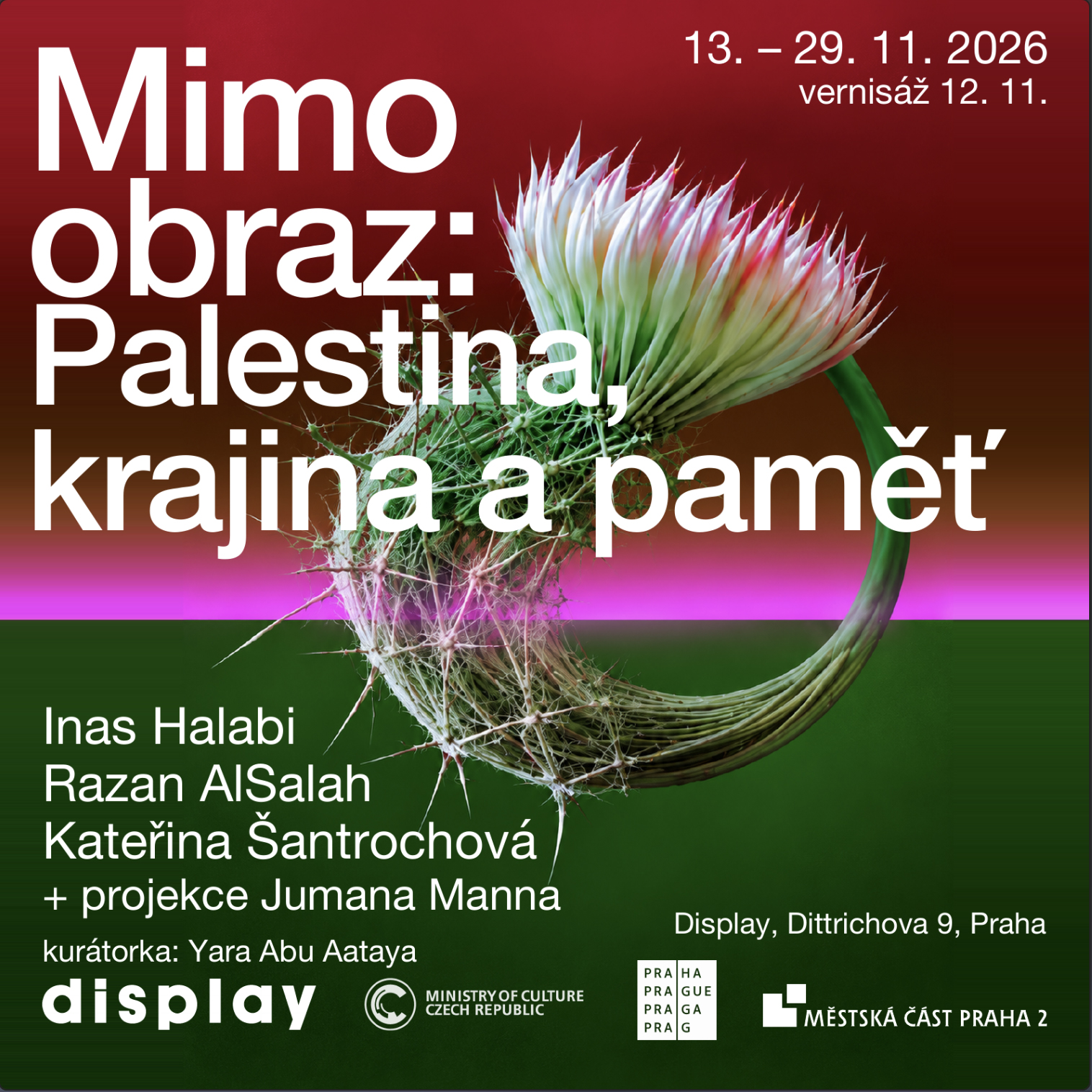
Outside the Image
✧ Join us at Display Gallery for the opening of our next exhibition, Outside the Image
✧ What remains outside the image of Palestine we already know? In Czech public discourse, Palestine appears primarily as a news and political image: war, security, humanitarian catastrophe, geopolitical conflict. Such an image is inevitably reductive. It pushes aside everything that falls beyond its frame: everyday life, the memory of place, family histories, the body and the landscape. It also leaves unanswered the question of who depicts Palestine, from what position, and for whom. This exhibition does not seek to produce yet another image of Palestine. Instead, it brings together three works that engage with what is fragmentary, erased or physically inaccessible. In The Right of Return, Inas Halabi draws on research into the remains of destroyed Palestinian villages. The film material bears the physical traces of security inspections, becoming a carrier of both the landscape’s memory and the violence inflicted upon it. Razan AlSalah’s film Your Father Was Born 100 Years Old, and So Was the Nakba follows a grandmother who returns to her native Haifa through Google Street View. Here, the digital image stands in for a place that can no longer be reached, while also bearing witness to what has disappeared from it. Foragers by Jumana Manna, presented as a one-off screening during the opening, approaches the politics of landscape through plants, food and the knowledge passed down among foragers, whose ways of life come into conflict with nature conservation regulations. The exhibition begins with a scent. The Ritual of Return is an olfactory composition created by Kateřina Šantrochová (Scent Roche). It has been composed to evoke the scent of my grandfather’s orchard in Gaza. Visitors encounter it before any image: the first room is devoted entirely to the scent and, during the opening, to the screening of Foragers. This is followed by an intentionally open, empty space, before visitors enter the room housing Halabi’s and AlSalah’s installations, the images themselves. The scent gently carries over into this space, offering something that an image cannot convey: a memory of place that cannot be photographed or explained, yet remains present. In this sense, it is quite literally what exists outside the image. Together, the works raise the question of what an image can hold onto when places are destroyed, family ties severed, and the very possibility of return rendered inaccessible.